Monday, 13 July 2015

Importance of proper bike fit - Guest Article by Bharat Krishna v

Bicycles come in various different sizes, geometry and components. Bike manufacturers use adjustable components so that a rider can be properly accustomed to a bike. With the help of trained bike fitters who know the adjustments that are needed to be made to the components so that a rider is comfortable with the bike.

The benefits of bike fit can be best experienced by;
  • Beginners
  • People who can’t get comfortable with their present bike setup.
  • Competitive cyclists.
Professional riders need a bike fit to maximise their efficiency. Experts are known to refine their riding positions. A professional bike fit should be considered as an investment that will be paid off as long as you ride your bike. As a recreational rider or beginner, you may have questions regarding what a professional bike fit can offer? Here are some of the benefits of professional bike fit.

• Improved performance:
Your bike is set so that you get maximum performance. When your body is set in a position that you get proper muscle engagement and proper muscle recruitment. It will allow the rider to use multiple muscle groups in most effective and efficient manner, produce better power that enhances your endurance capabilities and perform to your optimum level.

• Improved comfort:
A professional bike fit makes sure that your legs are in the proper position while you are riding and get maximum comfort. Your leg is set in a bio-mechanically neutral position which minimizes the load on your muscles and joints.

• Better selection of equipment:
Many people buy bicycles based on brand names. But there are chances that top brands produce products that doesn’t fit you well. This is the case of most beginner riders. This can result in the purchase of an expensive and very compromised bike which you will not like to ride on. Proper bike fitting can find you good components that suit your riding. This can save you a lot of money.

• Reduce fatigue:
Many riders experience numbness on their foot, hands, genitals etc. This is due to the lack of proper bike fit. A proper bike fit can reduce fatigue, numbness, injuries and helps you recover faster. In a bike fitting session, lot of adjustments are done. Both to the bike and also your riding posture. Some basic adjustments done while doing a basic bike fit are:

• Saddle level:
Depending on the rides you do and the physical problems you have whilst riding, the saddle level is adjusted accordingly.
Saddle needs to be at level to avoid knee pain or back pain. (Pic courtesy: https://www.canyon.com/en/service/supportcenter/article.html?supportcenter_articles_id=148 )
• Saddle height:
Improper saddle height can cause pain all over your body. It is really important that you have a proper saddle height whilst riding for efficient transfer of power to the pedals.
Adjust Saddle height to ensure adequate stretch without allowing the Knees to lock
• Handlebar reach:
This adjustment is made to give you better breathing and power. If you want to be aerodynamic, you get down on the drop bar.

• Ride position:
Your ride position is corrected so that you get to ride different terrains more efficiently. Mainly your back should be straight, relaxed shoulders and a slightly bent elbow.

• Setting clip-less pedal cleats:
If you are using clip-less pedals, an improper setting will give you pain on your foot. A proper orientation of clip-less pedal cleats is necessary for an injury-free ride.

• Stem length:
The length of the stem that comes custom on your bike may not suit everyone, improper stem length can cause severe back pain. So the stem length is determined that suits your body posture.
Dr. Kristophe de Timze (M.I.T) comes up with easy thumb-rules for Bike fit (Photo courtesy: http://cyclingtips.com.au/2010/04/science-of-bike-fitting/ )
Given above are some of the adjustments done while doing a bike fit. Every one needs a proper bike fit. Today, there are a lot of professional bike fitters. Fitting can be great and give a jumping off point to your riding. But make sure that you go to the right person to do the fit so that your money is well spent for the long run.

Ride responsibly.

Wednesday, 1 July 2015

Proper nutrition and hydration for long rides - guest article by Bharat Krishna V

Nutrition and hydration plays a prominent role in a rider’s performance and recovery. Even really talented and hardworking professional rides find it difficult to reach the podium without following a proper diet and hydration. Maintaining optimum hydration while doing long rides is very important, but many riders do not know this fact. Proper nutrition and hydration helps you overcome muscle cramps, fatigue and injuries.

It’s difficult to do this unless you practice. Hydration is one of the easiest things to do, but equally neglected. Here are a few tips that need to be practiced to stay properly hydrated and nourished.
  • You should be frequently and consistently drinking while on the move. Mainly water, electrolyte or maybe diluted fruit juices. The worst thing about staying properly hydrated is that it causes a tendency to pee. It’s normal that cyclists have the urge to pee at least once every hour. 
  • The amount of water a person loses from his body in an hour varies. But an average person has to drink about 600ml-800ml of water. Adjust your hydration according to your body needs.
  • Ensure you hydrate yourself before you eat that you won’t mistake thirst for hunger.
  • During long rides, its good to carry two bottles . One filled with water and other can be your favourite drink. If it does not contain electrolytes, you should be carrying some sodium tablets or ORS.
Calorie intake and hydration go hand in hand as each influences and facilitates the other. It’s important the you are properly nourished to attain optimum performance whilst riding.

People respond differently to different types of food. Many professional cyclists consume energy bars and energy gels which help them maintain their calorie intake. But many do not prefer artificially prepared performance foods. Many people have problems in digesting energy bars and gels.

It’s good to take along with you some bananas, chocolates, nuts etc which can satisfy the need for carbohydrates. Many people consider swapping from electrolyte to energy drinks that contain carbohydrates according to the intensity of the ride.Typically if you are planning to do 4 hour ride, its necessary that you take at least 3500 calories, 100g proteins, 80g fat and about 600g of carbohydrates. This consumption varies from person to person and the intensity of ride. Here are some of the foods that you may consider to eat.
  • Porridge/Oatmeal for break fast. This is a low glycemic index food which is really good for cyclists as they are a firm source of proteins and give a slow and steady release of energy. You can make it more tastier and healthier by adding some fruits, raisins or nuts. 
  • Coffee: A strong cup of coffee can provide caffeine that improves your endurance performance through altering muscle metabolism and increasing mental alertness. Its important that you try caffeine in training before a long ride/race to assess you own response to it.
  • Nuts and seeds: Nuts like almonds, walnuts and seeds like pumpkin seeds are a good source of protein and fat and provide a lot of calories.
  • Rice: It contains the most essential carbohydrates and its high on glycemic index which means it gets glycogen right into the bloodstream. Eat before or straight after your ride as it’s good for recovery. 
  • Vegetables: It contains the essential vitamins and minerals. It is a great source of carbohydrates and when compared to fruits, its low on sugar which makes it a great food for cyclists.
Apart from the above foods mentioned, there are many other foods that help cyclists maintain their nutrition levels. Riders have their own personal favourite foods. You should be taking the right food at the right time. As hydration and nutrition are important, recovery after a ride is also equally important as post ride exercise is essential to replace the muscle glycogen used, stimulate muscle protein synthesis and replace electrolytes. So it’s really important that you recover quickly after a ride providing your body with necessary nutrients and fluids. Remembering this thumb rule will help you in your rides “Eat before you are hungry, drink before you are thirsty”.

Ride safe. Ride responsibly !

Wednesday, 10 June 2015

What we packed for a Winter Trip Through the Himalayas - by Arushi Jain

You think biking in the undulating terrain of the Himalayas is a tedious task? Well, try adding to it the relentless chill of the winters, a thick covering of snow and biking miles without a soul in sight. Crazy? Impossible? Nah, not really. Rishab, Pankaj and Naveed just completed this monumental task.
Rishab, Pankaj and Naveed on their Epic trip (Pic courtesy: http://www.untold.in/insearchofthestorm/)
To get you a glimpse of their perseverance and planning, we asked them a series of questions. If you’re daring enough to take such a trip, these tips might come in quite handy.

What kind of clothing is required for a trip to the Himalayas during winters?
To keep yourself warm you need atleast four layers of clothing – thermal, t-shirt, insulated jacket and waterproof pants. Everything you wear needs to be waterproof as there would be snow all around. Staying dry is extremely important. 
Highly insulated boots along with gaiters are a must. The boots should have a good grip on ice. Numb toes are a nightmare on such a trip.
Insulated boots are a must (Pic courtesy: http://www.untold.in/insearchofthestorm/)
Face mask is also important to save your face from the absolutely chilly air. Another thing you need to keep in mind is to wear sunglasses to avoid snow-blindness, eye damage caused by snow reflecting the UV light.

Key: Make sure you’re covered properly. No part of your body should be left exposed.


How much food did you carry with you?
For every trip, you need to carry emergency ration with you. You have to be prepared for the worst scenario. We stopped at villages and other places to refill our food supply. This required a lot of forethought, since during winters most of the villages are desolated and very few villagers stay back.  Maggi and tea were available in a lot of tea stalls. We also packed a lot of dried fruits. When you have nothing else to rely on, dried fruits are your saviour. They are perfect for such a trip as they are high in calorie, easy to carry and also keep you warm.

Key: Plan ahead. Stop at villages to refill. Carry dried fruits.


How did you find shelter and keep yourself warm at nights?

One of our main intention while taking this trip was to interact with the locals and learn from them. We picked up a lot of indigenous ways of keeping ourselves warm. Locals were very welcoming and opened their homes to us. In Kalpa, we stayed at a villager’s house for two nights.

\What we observed was that the locals kept a fire burning throughout the day to keep the house warm. They only put it out at night. Their houses were made of mud and had really thick walls to provide proper insulation. They also had a diet which included a lot of butter and ghee.

Key: Interact with locals. Learn from them. They have a lot to teach.


How would the dynamics of the trip change if you took the same trip during Summers?

Season has a big role to play in any trip. Even though the altitude remains the same during summers, the external conditions vary significantly. In summers, the villages are more populated. It becomes easier to keep yourself warm. You don’t even need to pitch a tent as a number of local guest houses and summer camps are there along the way.
Most villagers move to warmer areas during winters (Pic courtesy: http://www.untold.in/insearchofthestorm/)
In winters, the villages are desolated. Most of the villagers go to warmer areas and very few villagers stay back. The ones who stay back have a very limited supply of food and other essential commodities. The journey becomes a lot more difficult and good planning becomes mandatory. 

Key: External factors come into play. Winters are more challenging.


If you had to take only 5 things with you on such a trip, what would those things be?

1.      Good Insulated Footwear
Footwear is a lot more important than we think. Since you have to cycle a lot, you cannot risk taking inappropriate footwear with you. Numbness in the toes can be very uncomfortable.

2.      Camera
Every trip is special in its own way and you want to capture everything you see and everything you do. Explaining that experience is words is not possible. In fact, even the camera cannot do justice to what you experience. However, the photographs and videos do give you a glimpse of it and you can treasure it for life.

3.      Device Chargers
Luckily, in Himachal the connectivity is much better than places like Ladakh. It is important to have your devices charged. You need backup of all the photographs and videos.  

4.      Enough Food
It’s strange, but during such trips you crave for your favourite food and you feel like going back home and eating it. So, make sure you eat all your favourite things before the trip and probably take some with you.

5.      Good Company
I feel that it’s all meaningless if you don’t have anyone to share this experience with. You can’t go ahead on your own. There were times when we didn’t see a single person for hours. We also saw bear tracks along the way. Completing such a journey alone becomes a near-impossible task. It gets lonely and having someone with you helps. You watch out for each other.

Key: There is no substitute to having a person to share the experience with.


How did you manage to charge all your electronic devices and gadgets?

We used to find government guest houses along the way. They are empty during winters and allowed you to use their ports. However, electricity is not available 24*7. So, you have to plan ahead and make sure you take back up of all your pictures, video recordings and other files.
Some locals also allow us to charge our devices. Some of them had generators installed in their homes. In such villages, electricity is available for only 1-2 hours a day. So, you need to know how much your device will charge in that much time.

Key: Sometimes, less is more.

What advice would you give to other cyclists who are daring enough to take such a challenging trip?

We were told that it is not possible in winters. We challenged ourselves and said maybe nobody has tried it before. Maybe it’s doable. So, we planned it all out. Prepared for it, mentally and physically. We realised that it is doable. It’s absolutely doable. A lot of planning and precision is needed.

The key to such trips is having the right equipment. Faulty equipment will definitely put you in trouble in one way or the other.

Key: Determination will take you a long way. Right equipment will get you out of the worst situation.


Is there anything special you want to share about this journey?

We’ve cycled from Kanyakumari to Kashmir and we are no strangers to the Himalayas. During this trip, we realised that the exact same place can offer you multiple experiences. We’d visited the same places 6 months back, but this time when we saw them, we couldn’t recognize them at all! The lush green apple orchids were dry and covered in snow. The rivers we had seen were now in a semi-frozen state. It was a completely fresh experience.


Key: The same place can offer you multiple experiences. 

To read more about this adventure, do check out http://www.untold.in/insearchofthestorm/ . We promise, the photos will leave you breathless! 

Tuesday, 9 June 2015

What to carry while mountain biking? - Guest post by V. Bharat Krishna


It’s not what you want that matters but what you need. While packing for a mountain biking ride you need to have the right tools and parts so that you overcome any situation that may arise. If you are a beginner, you will have a tendency to pack all the tools and accessories you have but all that’s not necessary. Well, if you are planning for a whole day’s ride you need to carry the necessary food and drinks.

Portable Air Pump
  • Sandwich
  • Banana
  • Nuts (Almonds, Brazil nuts etc.)
  • Energy bars
  • Water or Electrolyte drink
Here are the list of things that you must carry while riding :

1. Mini bike pump: You will need a good quality mini pump that can fit in both the presta and shrader valves. This can be an alternative for the expensive CO2 inflators and cartridges, which are much useful for racing.


2. Multi tool: Most good quality multi tool kits offer a chain breaker apart from the Allen keys so as to enable the rider to overcome issues with your chain. Never leave without this!
The Pedro ICM - a multi-tool with a chain breaker
3. Spare tubes: One or two should do. This is helpful even if you are running tubeless tires.

4. Tire levers: A three-piece or two-piece tire levers should do the job well. Tire levers are important to take the tube off the tire, in case of a flat.

5. Spare brake pads: Most mountain bikers use disc brakes so its safe to carry a pair of pads as some pads wear out easily.

6. First aid kit: How much ever experienced rider you are, you must carry this. You must include an antiseptic, Band-Aids, cotton, gauze wraps and maybe some pain killer tablets. It’s necessary that you need to know how to use the first-aid kit properly.

7. Rear derailleur hanger: It is the small metal part that connects the rear derailleur to your frame. It varies in size and shape for different bikes of different brands. It is a part that has to hold a lot of stress while riding so the chances for it being broken is so high and its frequent among mountain bikers.
Rear Derailleur hanger
8. Hydration bag:  Carrying a hydration bag while mountain biking is advantageous compared to carrying water bottles. Hydration bags can hold more volume of water (2-3L) and also can be used throughout the ride. But if you are using water bottles, you need to refill it from time to time. Moreover you can use a hydration bag while riding which is not possible while using water bottles.
Hydration bags offer a cleaner and more efficient way of carrying water
9. Mobile phones: This does not need elaboration, and can be a real lifesaver in case of emergencies. Keep people at your home informed. Its necessary that you have an Emergency contact-number that is displayed prominently or has been given to a fellow rider.

10. Money: Carry sufficient amount of money. Carry enough money to reach home in case of injury or mechanical failure by another mode of transport.

11. Torch/Headlight: If you are unable to reach home before dawn, this one take you home safely or help you in case of mechanical failure.

Above are some of the must have things that you should have in your backpack when you’re out on a mountain bike ride. Beyond this riders have their own needs. For me, the lesser I carry the faster and better is my ride. Apart from this, you need to wear proper riding gear, most importantly your helmet and pads.

Be safe on your bike. Ride responsibly! 

Thursday, 4 June 2015

Blogospheric Gems – Interesting Blogs about cycling, for cyclists! - By Arushi Jain

Have you ever thought how cool a sieve (sifter) is? No, I am not crazy, just think about it. It separates out the useful component from a mixture of different components. So, let’s just say we’re a cyclist-specific sieve and have taken up the gigantic responsibility of sifting out the best cycling blogs from the entire blogosphere. Here’s a list of our top cycling blogs.

Copenhagenize
This is a very interesting blog which highlights how Copenhagen transformed itself into a bike-obsessed city. We all can learn a thing or two from this blog and hopefully bring a change in our city as well. Hey, a girl can dream!

http://www.copenhagenize.com/

Fat Cyclist
This blog, started by Elden Nelson or “Fatty” captivates you with its heart-warming yet witty posts. His entries are about weight loss, cycling and occasional serious posts about his wife, Susan.

http://www.fatcyclist.com/

The Inner Ring
This is the most sought-after source of cycling news, race coverage, cycling heroes etc. Of course, the extensive collection of fantastic images brings everything to life. 

http://inrng.com/

London Cyclist
London Cyclist is probably the first blog every cycling-enthusiast gorges through. The weekly reviews of latest cycling clothing make sure that you bike in style.

http://www.londoncyclist.co.uk/

Bike Snob
With its massive following and readership, Bike Snob is definitely on every cyclists must-read list. The Snob is a total bully and has been tagged as a “bike culture denier”. He has a take on everything, like EVERYTHING going on in the cycling world.

http://bikesnobnyc.blogspot.in/

Tuesday, 2 June 2015

Our visit to Germany - heaven for mountain bikers!

So, we recently attended a Cycling Expo in Berlin (Germany) and the cycling scene there blew our mind away! The mind-blowing began at the airport, where we saw people riding these cycles INSIDE the airport
Cycles inside the Frankfurt Airport
However the true awesomeness of Germany starts when you land and start seeing the city, in my case the city of Berlin. The roads are, of course, absolutely amazing. But 2 things stand out when you visit Germany from India - the sheer number of cycles and cyclists there boggles you.
The cycles outside a building downtown outnumber the motored vehicles
In part, the number of cyclists in Berlin (or in Germany) can be explained largely to culture, to relatively smaller (and consequently crowded) downtown areas and the presence of cycling lanes. The cycling lanes makes cycling super-safe and at each signal, you have separate set of signal lights for cyclists, walkers and motorists. Though I couldn't take photographs, Germany even separate inter-city highways for cyclists! So, you could go touring from one city to another on a dedicated cycling highway.
Cycling Lanes are sometimes part of the road itself

Most often, cycling lanes are part of the footpath 
The Cycling lanes are mostly elevated and a part of the footpath. However, the footpaths were usually quite wide and provided adequate space to those who chose to walk. That most of the population cycles was also evident from the fact that right from small shops to large malls had cycling stands available for people to part their bikes safely.
Cycling Stand outside a small shop

A populated cycle stand outside an office building - you can see more in the distance
The above photo was taken in March, when winter was still continuing and it would snow (light snowfall) in the evenings! The temperature was in the single digits (of degrees Celsius) and rains and wind would further make it difficult to cycle. Imagine the number of cyclists in summer!
This is how the weather was - you can see the light snow! 
One would think that, give the abundance of cycles, it must be quite safe to park your cycles outdoors. In fact, throughout my time in Berlin, I felt very safe at all times. However I noticed that all cycles are locked with very heavy locks and chains like this:
Cycles tended to be locked to pillars or bike stands, with heavy locks
Upon talking to locals, I realized that bike thefts are quite common (at least by local standards) and hence, people almost always made sure the bikes were locked to a pillar or a bike stand. The next day, we went to the Expo (the reason for our visit to Berlin) and there again, as expected, we saw a massive bike stand:
Bike Stand at the Expo 
The Expo was something else all-together. First off, we see this ice-hockey ring, but with people on cycles playing inside! 
Ice Hockey on cycles! 
Even better was the indoor Mountain Biking arena! This wasn't uncommon in Germany and helped riders enjoy the thrills of mountain biking indoors during the harsh-winters.
The start of the indoor MTB arena

A rider goes up the first climb on the indoor MTB Arena

View of the Indoor MTB arena from the other end
The cool thing is that I saw a whole bunch of 6-10 year old kids on mountain bikes, fearlessly navigating their own Junior Arena!
Junior MTB arena!

PureFix Stall at the Expo - one of the many Fixie brands on display there!
Berlin has a tremendous Fixie scene - Fixies are quite common and appreciated there. So, it was nice to see the PureFix stall in the Expo as well. Of course, we had our own stall set-up in the accessories section!
The Lumos Stall at the Berlin Expo
At the expo, I also saw my first Penny-Farthing. Penny-Farthings are the original cycles - in fact, until 1880, these are what 'Bicycles' were called! Apparently, the modern bicycle (with both wheels of same size) was introduced in 1890 as a specialty 'safety bicycle'. At the Expo, I met a man who had done an entire Bike tour on his Penny Farthing - even today they are sold for their novelty value. 
Me with a Penny Farthing
Once the Expo was successfully concluded, we decided to take some time off, rent some bikes and roam the city of Berlin on our rental bikes. The problem is that you only get "City" bikes - really heavy Steel bikes with 3 gears for your ride. Though less fun to ride, it gave us an experience of riding in Berling. The predictability of bicycling riding and the safety is amazing. Coming from India, even after the signal turns green, we are used to looking at both sides before starting off on a junction. In Berlin, people just start off once the signal turns green.
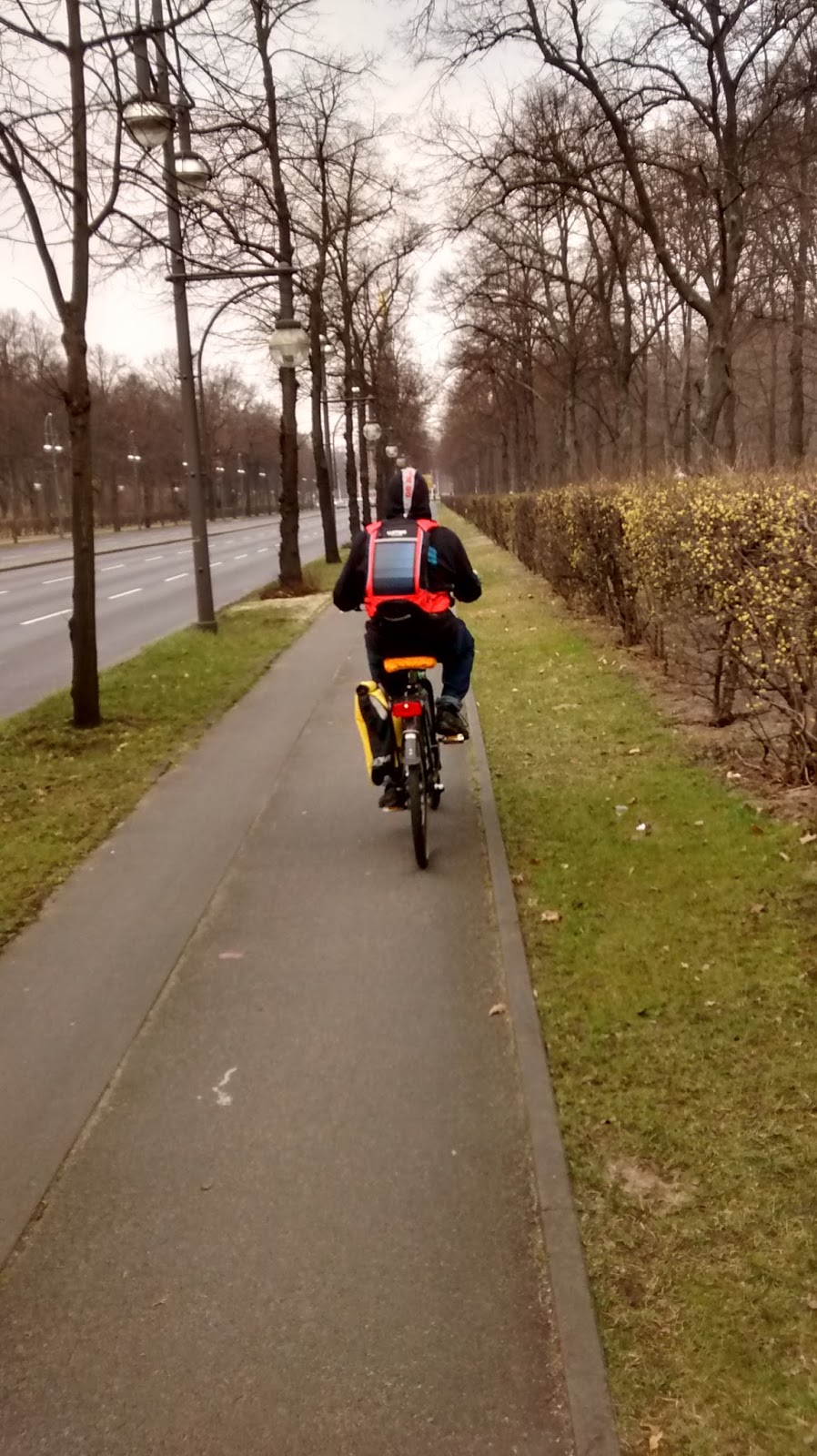
Sooraj, my teammate, on his rental through a Berlin park

My rental bike in the Berlin park, with our Prototype Pannier bag
While we rode through the Berlin, of course, we used the cycling tracks only. We did see a few folks cycling on the road, but those were the faster road-bikers. Also, coming from India, we find it odd to cycle without a helmet. However, in Berlin, we saw a good number of people cycling without helmets! To wear a helmet or not - this debate is seen to be jaded and avoided. The only conclusion we saw most Germans arrive at was - to each his own!
Me - on a beautiful cycling track in the middle of Berlin!
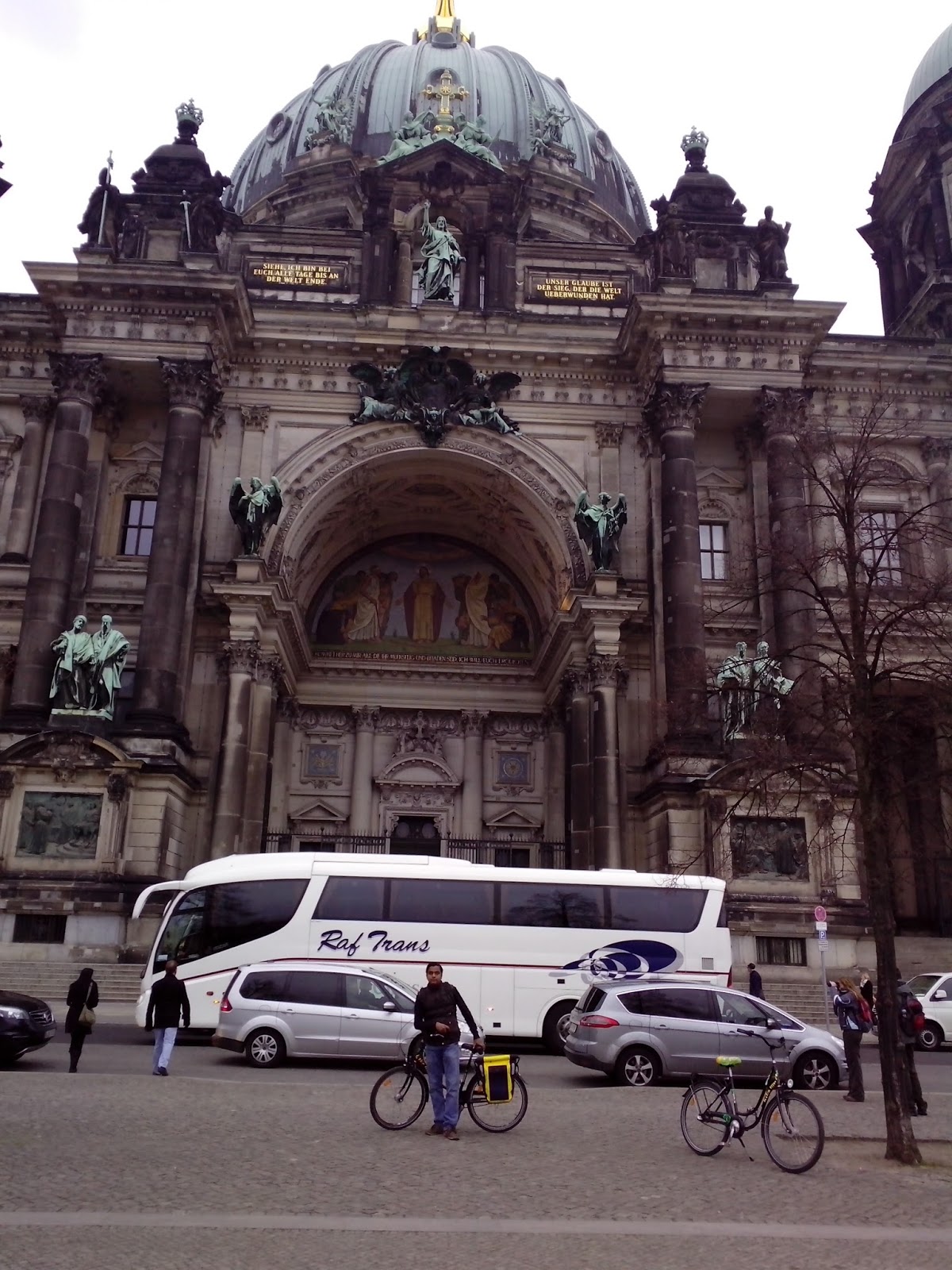
Berlin is a historic city - in downtown Berlin, you will find the most amazing historic buildings! The architecture will leave you amazed. Berlin is best explored on a bike though - the streets are narrow at times.
Sooraj in downtown Berlin.

More Berling Awesomness

A Panorama shot - Television Tower in Central Berlin

When I stopped for some train-watching!
During my stay, I also had the good fortune to visit the beautiful town of Wurzberg - a small and scenic town near Frankfurt. Though it was raining, it was nice to see people out cycling. You realize that in Germany, it rains so often that people just get used to it - they don't necessarily keep indoors during rains!
Such a sweet bike in Wurzberg

Central Wurzberg
For the final leg of the tour, we visited Frankfurt. In Berlin and in Frankfurt, getting bike rentals is super easy and affordable. The local railways runs a bike rental system which also is attached to an app. The app indicates the nearest available cycles, you select a cycle and the lock code (the cycles are locked by combination codes) is smsed to you. The rate was EU 1 per hour up to a maximum of EU 9 for 24 hours!
Bike rentals outside Frankfurt Station
I went out riding again in Frankfurt - it was a bright day. Though the locals were out running and cycling and enjoying the glorious weather, I still found it cold (it was 12 degrees Celsius).
My rental in Frankfurt! 
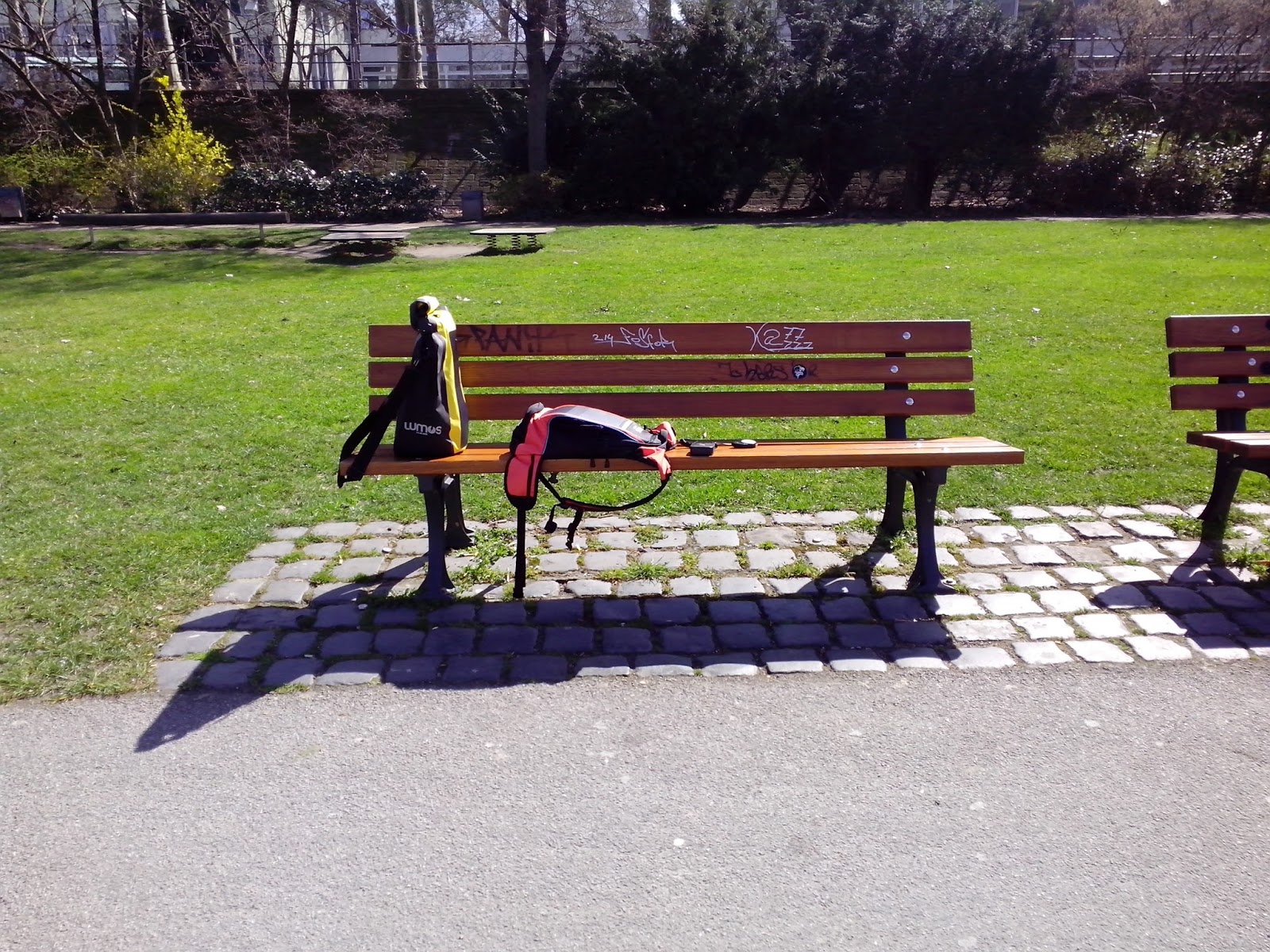
I also found an absolutely gorgeous jogging-cum-cycling path that went along-side the river in Frankfurt. I sat on a bench along the river, and let my bags sun-bathe a bit - which meant that we tested their solar performance. 
Lumos Solar bags sun-bathing and charging up in Frankfurt!
Cycling and jogging track along-side the river in Frankfurt
Thus ended the trip of Germany for me. All that cycling made me crave some hot Indian food, and I was lucky to find a Saravana Bhavan in Frankfurt! I rushed to it and ordered me a nice Chola Bhatura, which was spicy and felt so amazing in the cold weather. It seemed like a great conclusion to my trip. Though I enjoyed my trip of Germany, I had started to miss my own bike (a Giant Hybrid) back home and was craving to go on a nice long ride on my bike! Luckily, I ended up in Bangalore (India) on a weekday, with enough time to prepare for a 100km ride on the Sunday to get me back to action! 
Chola Bhatura at Saravana Bhavan

Odd to see a bar at the Saravana Bhavan in Frankfurt!


Monday, 25 May 2015

Techno-Zing: Useful Gadgets for a Cyclist - Guest article by Arushi Jain

Technology is an integral part of cycling these days . Let’s dive deeper and find out what it has in store for you, a cyclist.

1.      Garmin Edge 1000
Tread without fear with this trust-worthy bike-specific GPS-tracker. It is not just a conventional GPS tracker, it can measure your speed, time, distance, altitude, climb, descent, calories burned and your heart rate! It can also be paired with your smartphone. Not impressed yet? How do you feel about a Virtual Partner mode to race a virtual partner?

Garmin's Virtual Partner (Image Source: http://www.tramsoft.ch/) 

2.      Hokey Spokes
Yes, this gadget is as cool as it sounds. This makes a boring safety light into a really trendy light image and text on your bicycle wheels. I told you, it is quite cool. As soon as you start pedaling, the 16 built-in LEDs light up into images and form the “LED art”. Bring out the artist in you!
Making LED art with Hokey Spokes (Source: http://www.hokeyspokes.com/what.htm) 

3.      ICEdot Helmet Sensor
Accidents happen all the time. Things become a little more complicated for a cyclist because there’s a high probability that if you get into an accident, you’ll get through by the skin of your teeth or maybe end up losing a few. Your saviour in such a situation can be the ICEdot Helmet Sensor. Its tiny yellow dot detects accidents and sends an SMS to your emergency contacts. It is truly a life-saver!
The ICEdot Sensor alerts emergency contacts through SMS (Source: https://icedot.org)

4.      Wireless Bicycle Turn Signal
There’s more than one way of making yourself presence felt. This battery-powered turn signal device is one of them. It is equipped with ultra-bright LEDs and emits a loud beep whenever you make a turn. A must-use for a commuter to ensure you’re heard and seen.

5.      Helios Bars
Enjoy biking at night? Then this device is a solution to all your worries. It has GPS tracking and front and rear-facing LEDs. It doesn’t end here. The rear-facing lights change colour with your speed and also work as turn signals or indicators. Awesome, eh?
The Helios Drop bars claims to give "brains" to your bike (Source: http://www.ridehelios.com/products.php) 

What is the funkiest biking gadget you have come across? Do tell us!